

The Prayer of Confession: Naming the Acts of the Flesh (Galatians 5:19–21)
Tuesday morning. Your phone buzzes before your feet hit the floor. You roll over, thumb already moving, and forty-five minutes later you've scrolled through three arguments, two vacation photos from people you barely like, and one headline that made your stomach drop. Somewhere in there you meant to pray. You didn't.
Now add this: yesterday you snapped at your daughter over nothing. Last week you felt that familiar twist of envy when Marcus got the promotion. Three days ago you said something sharp about Sarah that you'd never say to her face.
Most of us have prayed "forgive my sins" for years without ever naming one of those things. That's the gap a prayer of confession is meant to close. Paul didn't mumble his way through Galatians 5:19–21. He wrote the sins down, out loud, in a list. He named sexual immorality and debauchery, yes, but also hatred, discord, jealousy, fits of rage, selfish ambition, envy. If the list made Paul uncomfortable to write, it should make us uncomfortable to read. And that discomfort is the point: unnamed sin quietly hardens us, while named sin can be brought to the cross and left there.
In this guide:
- Why Paul Lists the Acts of the Flesh Out Loud
- What Counts as an "Act of the Flesh"? A Plain Reading of Galatians 5:19–21
- Confession vs. Apology: What a Real Prayer of Confession Sounds Like
- How to Pray a Daily Confession Prayer (A Simple 4-Step Pattern)
- Confessing Without Shame: The Difference Between Conviction and Condemnation
- From Confession to Fruit: What Galatians 5:22–23 Says Comes Next
- When You Confess the Same Sin Again Tomorrow
- Making Confession a Daily Habit, Not an Occasional Crisis
- Frequently Asked Questions About the Prayer of Confession
Why Paul Lists the Acts of the Flesh Out Loud
Paul could have written, "the acts of the flesh are obvious — you know what they are." Instead he spelled them out. Verse 19 opens with "The acts of the flesh are obvious," and then he names them anyway. That's deliberate. He wanted the Galatian believers, and us, to stop hiding behind generalities.
A vague confession feels safe because it costs nothing. "Lord, forgive my sins" is true, but it's also a way of keeping the actual thing in the dark. You can pray that sentence for a decade and never once say the word envy, never once admit that the sharp thing you said to your wife on Tuesday was a fit of rage, not just "a rough morning."
Naming sin is not self-punishment. It's honesty. And honesty is the doorway into real change.
What Counts as an "Act of the Flesh"? A Plain Reading of Galatians 5:19–21
Paul's list falls into rough groups. Reading it plainly is uncomfortable, which is exactly why it works as a diagnostic:
Galatians 5:19–21 (NIV): "The acts of the flesh are obvious: sexual immorality, impurity and debauchery; idolatry and witchcraft; hatred, discord, jealousy, fits of rage, selfish ambition, dissensions, factions and envy; drunkenness, orgies, and the like. I warn you, as I did before, that those who live like this will not inherit the kingdom of God."
Grouped out:
- Sexual sins — immorality, impurity, debauchery. The ones we talk about most.
- Religious sins — idolatry, witchcraft. Anything we trust or consult instead of God.
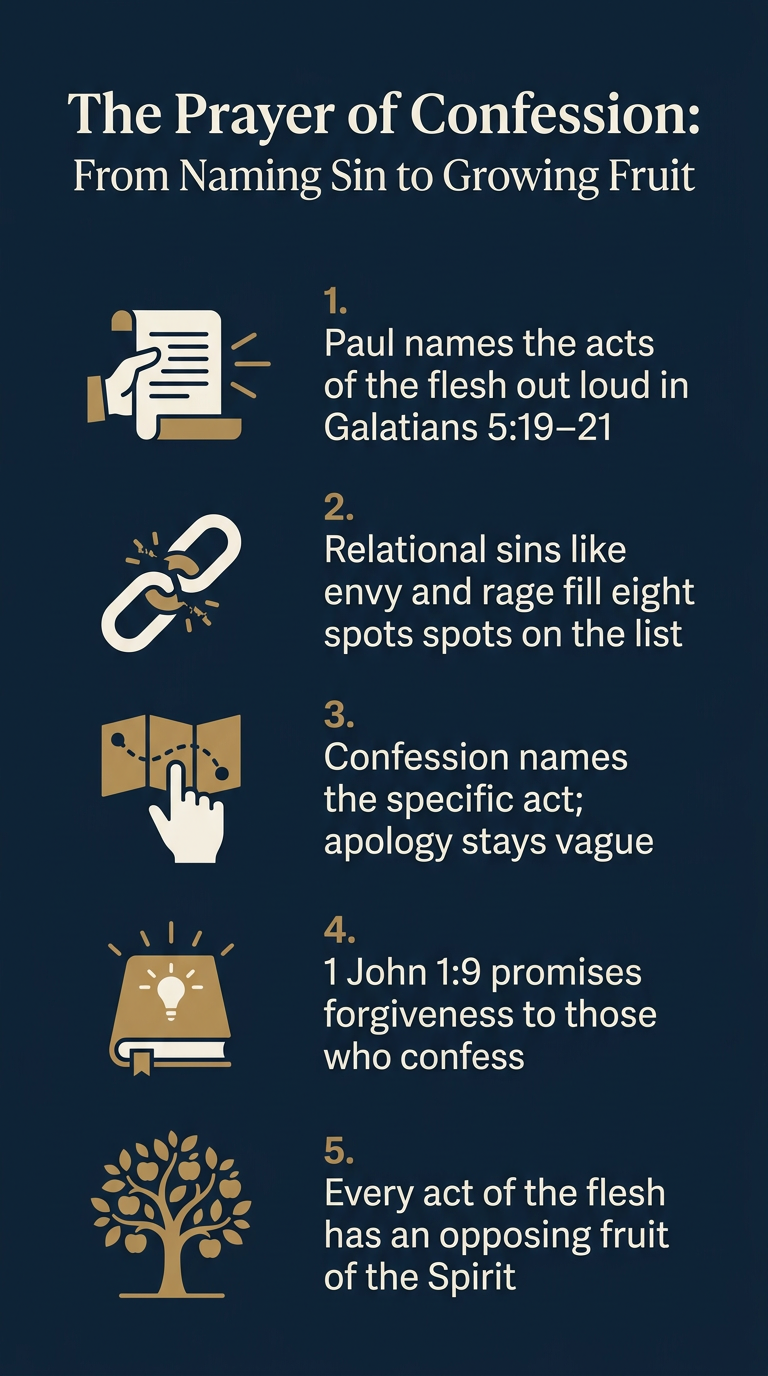
- Relational sins — hatred, discord, jealousy, fits of rage, selfish ambition, dissensions, factions, envy. The longest group in the list.
- Bodily excess — drunkenness, orgies, and the like.
The relational sins take up the most space. Eight of them. Most of us skim straight past that half and camp on the sexual ones, because those feel like "real" sin and the relational ones feel like personality. They aren't. A short fuse is an act of the flesh. Envy of a coworker's promotion is an act of the flesh. Gossip that splits a small group is a faction.
Paul ends with "and the like," which means the list isn't exhaustive. It's a mirror. Read it slowly and ask which line your name is written next to. That's not morbid introspection; that's the first step of a real confession.
Confession vs. Apology: What a Real Prayer of Confession Sounds Like
An apology is vague. Confession is specific.
| Vague apology | Prayer of confession | |
|---|---|---|
| Words | "Sorry for my sins." | "Lord, I was jealous of Marcus's promotion and I spoke badly about him to Sarah." |
| What it names | A category | An act, a person, a moment |
| What it produces | A vague sense of being forgiven | A clear conscience and a specific next step |
| What it asks for | Relief | Change |
The difference isn't eloquence. It's naming. You don't need fancy words. You need the actual thing. "Lord, I snapped at my daughter over nothing because I was tired and I wanted to be right. That was a fit of rage. Forgive me."
First John 1:9 is the anchor here: "If we confess our sins, he is faithful and just and will forgive us our sins and purify us from all unrighteousness." Look at what the promise is tied to. Confessing. Not feeling bad enough. Not waiting until the emotion passes. The promise attaches to the naming.
And notice the word just. God isn't doing you a favor by forgiving you grudgingly. Because of Christ, forgiving confessed sin is the just thing for Him to do. Your confession doesn't earn forgiveness; it receives what's already been paid for.
How to Pray a Daily Confession Prayer (A Simple 4-Step Pattern)
Here's something you can actually do tomorrow morning. Four steps, five minutes, no devotional book required.
1. Quiet yourself and ask the Spirit to search you.
Pray Psalm 139:23–24: "Search me, God, and know my heart; test me and know my anxious thoughts. See if there is any offensive way in me, and lead me in the way everlasting." You don't have to hunt for your sin. Ask God to show you. He will.
2. Name the specific act of the flesh from the past 24 hours.
Not the past life. The past day. What did you say, think, or do that belongs on Paul's list? Say it plainly. "Lord, I was envious of my neighbor's new truck." "Lord, I let my temper run at my son." Name it like you'd name it to a doctor, because you're asking for healing, not a lecture.
3. Receive the forgiveness promised in 1 John 1:9.
Thank Him for it and move on. This is the step most of us skip. We confess, then spend the rest of the day re-litigating whether God really meant it. He did. "If we confess our sins, he is faithful and just." Take Him at His word.
4. Ask for the fruit of the Spirit that opposes that sin.
This is the step that changes everything. Don't just ask for the sin to be removed. Ask for the opposite virtue to be planted. Rage needs forbearance. Envy needs love. Selfish ambition needs gentleness. Drunkenness needs self-control. Confession becomes forward-looking instead of just backward-looking.
Write these four steps on a card if you need to. The point isn't the formula. The point is that you have words ready before the day starts, instead of a vague guilt you carry all day.
Confessing Without Shame: The Difference Between Conviction and Condemnation
This is the objection that keeps most believers from praying a daily confession prayer at all: I'll just feel terrible about myself. So let's be clear about two things that feel similar and are not the same.
Conviction comes from the Holy Spirit. It's specific ("you lied to your boss on Thursday"), it leads you toward God, and it ends in peace. Conviction says, this thing is wrong, and there's forgiveness for it right here.
Condemnation comes from the enemy. It's vague ("you're a fraud"), it drives you away from God, and it ends in despair and hiding. Condemnation says, you're too far gone to bother praying.
Romans 8:1 settles it: "Therefore, there is now no condemnation for those who are in Christ Jesus." If what you're feeling drives you to hide from God, that isn't the Spirit. The Spirit always drives you toward the Father, because He's a Father who runs to meet His children.
So if you confess and then spend the day feeling dirty, you didn't overdo the confession. You skipped step three. You named the sin but didn't receive the forgiveness. Confession is a doorway into grace, not a punishment you endure.
From Confession to Fruit: What Galatians 5:22–23 Says Comes Next
Paul doesn't leave us staring at the list. Two verses later he gives the alternative:
Galatians 5:22–23 (NIV): "But the fruit of the Spirit is love, joy, peace, forbearance, kindness, goodness, faithfulness, gentleness and self-control. Against such things there is no law."
And then verses 24–25: "Those who belong to Christ Jesus have crucified the flesh with its passions and desires. Since we live by the Spirit, let us keep in step with the Spirit."
Every act of the flesh has a fruit of the Spirit that opposes it. Pair them in your confession:
- Fits of rage → ask for forbearance and peace
- Envy and jealousy → ask for love and joy
- Selfish ambition → ask for gentleness and kindness
- Drunkenness → ask for self-control
- Hatred and discord → ask for goodness and faithfulness
This reframes the whole prayer. You're not just asking God to take something away. You're asking Him to grow something in its place. That's what sanctification looks like. Not an empty space where sin used to be, but fruit growing in the soil.
When You Confess the Same Sin Again Tomorrow
If you've confessed the same thing five days in a row and you're starting to wonder whether any of this is working, hear this: repeated confession is not failure. It's the normal Christian life.
David wrote Psalm 51 after adultery and murder, and he still had to keep walking with God for the rest of his life. Peter denied Christ three times in one night, and Jesus restored him three times over breakfast. Sanctification is slow. If you're confessing the same short temper on day six that you confessed on day one, that doesn't mean the prayer failed. It means you're still in the fight.
The question isn't "did I sin again?" You will. The question is "did I come back?" That's what repentance is. Not sinless perfection, but a habit of returning.
So what does tomorrow morning's confession sound like when it's the same sin? It sounds like this: "Lord, I lost my temper at my son again yesterday. Same as last week. I hate that this is still in me. Forgive me. Give me forbearance." You don't need new words for an old sin. You need to keep showing up with the old words until God does what only He can do.
If you want to go deeper on why daily consistency matters more than occasional emotional intensity, the idea behind the app walks through the parable of the ten virgins and what it means to keep the lamp burning.
Making Confession a Daily Habit, Not an Occasional Crisis
If you only confess when things fall apart, you'll only pray when things fall apart. That's the rescue pattern: a blowup on Tuesday, a desperate prayer that night, then silence for three weeks until the next blowup. The confession never gets ahead of the sin because it's always chasing it.
Confession works best as a rhythm. Built into the first fifteen minutes of your day, before the phone, before the inbox, before the kids are up. A set time and a set place. Morning is best, because it puts confession before the day's temptations instead of after them.
That's the whole idea behind Light Keeper. We built an app that blocks your phone until you've completed your daily prayer, because we believe the morning belongs to God, not to the feed. It's a fence around the most important fifteen minutes of your day. If you're curious who's behind all this, the story of how it started is worth a few minutes.
So here's the decision: tomorrow morning, before you touch your phone, name one act of the flesh out loud to God. Just one. Say it plainly, receive the forgiveness in 1 John 1:9, and ask Him for the fruit that opposes it. Then do it again the next day.
The lamp doesn't refill itself. Keep it burning.
Frequently Asked Questions About the Prayer of Confession
Do I have to confess every single sin?
No. That would be impossible, and it would turn confession into a checklist instead of a relationship. Psalm 19:12 says, "But who can discern their own errors? Forgive my hidden faults." Confess what the Spirit brings to mind, and trust God's grace for what you can't see. The goal is honesty, not exhaustiveness.
Is confessing to God enough, or do I need to confess to a person?
For sin against God, confession to God is enough. First John 1:9 makes no mention of a mediator. But Scripture also says to confess your sins to each other (James 5:16) and to make things right with anyone you've wronged (Matthew 5:23–24). If your sin hurt someone, go to that person too. That's not for forgiveness; it's for repair.
What if I don't feel forgiven?
Feelings are not the measure of forgiveness. First John 1:9 says God is "faithful and just" to forgive. That's a fact about His character, not a feeling in your chest. Thank Him for it even when you don't feel it. Feelings usually catch up later. If they don't, that's often condemnation talking, not the Spirit.
How long should a confession prayer be?
As long as it takes to name the actual thing. Sometimes that's thirty seconds. Sometimes it's ten minutes. The length doesn't matter; the specificity does. A short, honest confession beats a long, vague one every time. You're not writing an essay. You're talking to your Father.
Can I confess the same sin every day?
Yes. And if it's a sin you're genuinely struggling with, you probably should. Repeated confession isn't a sign that God's forgiveness failed. It's a sign that you're still in the fight. The believer who confesses the same sin daily is in a far better place than the one who stopped noticing it.