

The Spiritual Discipline of Self-Control: A 30-Day Prayer Challenge
Most believers don't have a willpower problem. They have a prayer problem. You've white-knuckled your way through quitting the scrolling, the snacking, the snapping at your kids, and it worked for about four days. That's not a character flaw. That's the flesh doing exactly what the flesh does. A 30-day prayer challenge beats a 30-day resolution every time, because self-control isn't something you manufacture. It's fruit.
Why Self-Control Is a Fruit, Not a Chore
Read Galatians 5:22-23 slowly: "But the fruit of the Spirit is love, joy, peace, forbearance, kindness, goodness, faithfulness, gentleness and self-control." Notice what's missing. There's no command to grit your teeth and produce it. Self-control is listed alongside joy and peace—things you receive, not things you achieve. You don't strain to be joyful. You abide, and joy shows up. The same is true here.
Fruit grows slowly, in soil, under the care of someone other than you. That distinction changes everything about how you approach a challenge like this one. If self-control is a fruit, then your job isn't to squeeze harder. Your job is to stay connected to the vine. Jesus said it plainly in John 15:5: "Apart from me you can do nothing." Not "apart from me you'll struggle a bit." Nothing.
So here's the honest question: how much time do you actually spend connected to the vine? If your answer is "about ninety seconds before bed, on the nights I remember," then you already know why the fruit is sparse.
We built Light Keeper around this exact idea—that consistency in prayer is the soil where the fruit grows. Not a guilt trip. Not a religious checklist. Just a daily habit of showing up, and letting the Spirit do what only the Spirit can do. If you want the longer version of why we built it that way, our post on keeping the lamp burning walks through the thinking.
What the Bible Says About Self-Control (and Why We Struggle)
Scripture doesn't tiptoe around the struggle. Galatians 5:19-21 names the acts of the flesh in blunt terms: "sexual immorality, impurity and debauchery; idolatry and witchcraft; hatred, discord, jealousy, fits of rage, selfish ambition, dissensions, factions and envy; drunkenness, orgies, and the like." Paul isn't describing pagans out there somewhere. He's writing to a church.
Then verse 17 explains why willpower fails: "For the flesh desires what is contrary to the Spirit, and the Spirit what is contrary to the flesh. They are in conflict with each other, so that you are not to do whatever you want." You have two natures pulling in opposite directions. That's not a bug in your spiritual life. That's the normal Christian experience.
Look at how the Bible talks about self-control elsewhere:
- 1 Corinthians 9:24-27 — Paul describes the Christian life as athletic training. "I strike a blow to my body and make it my slave," he writes. Discipline is real. But notice Paul isn't training for his own glory; he's training to "get a crown that will last forever."
- Titus 2:11-12 — "For the grace of God has appeared that offers salvation to all people. It teaches us to say 'No' to ungodliness and worldly passions." Grace teaches. It's not just forgiveness for failure; it's the instructor that trains you out of it.
- Proverbs 25:28 — "Like a city whose walls are broken through is a person who lacks self-control." No walls, no defense. Your phone at 11 p.m. is a city gate standing wide open.
Now be specific about your own gates. Is it the phone in bed—an hour of scrolling you can't account for? A temper that flares at the smallest provocation? The second helping you didn't plan on? A lust you've confessed a hundred times? Paul's list in Galatians covers all of it, and so does the solution. Willpower treats the symptom. Prayer goes after the source.
How the 30-Day Prayer Challenge Works
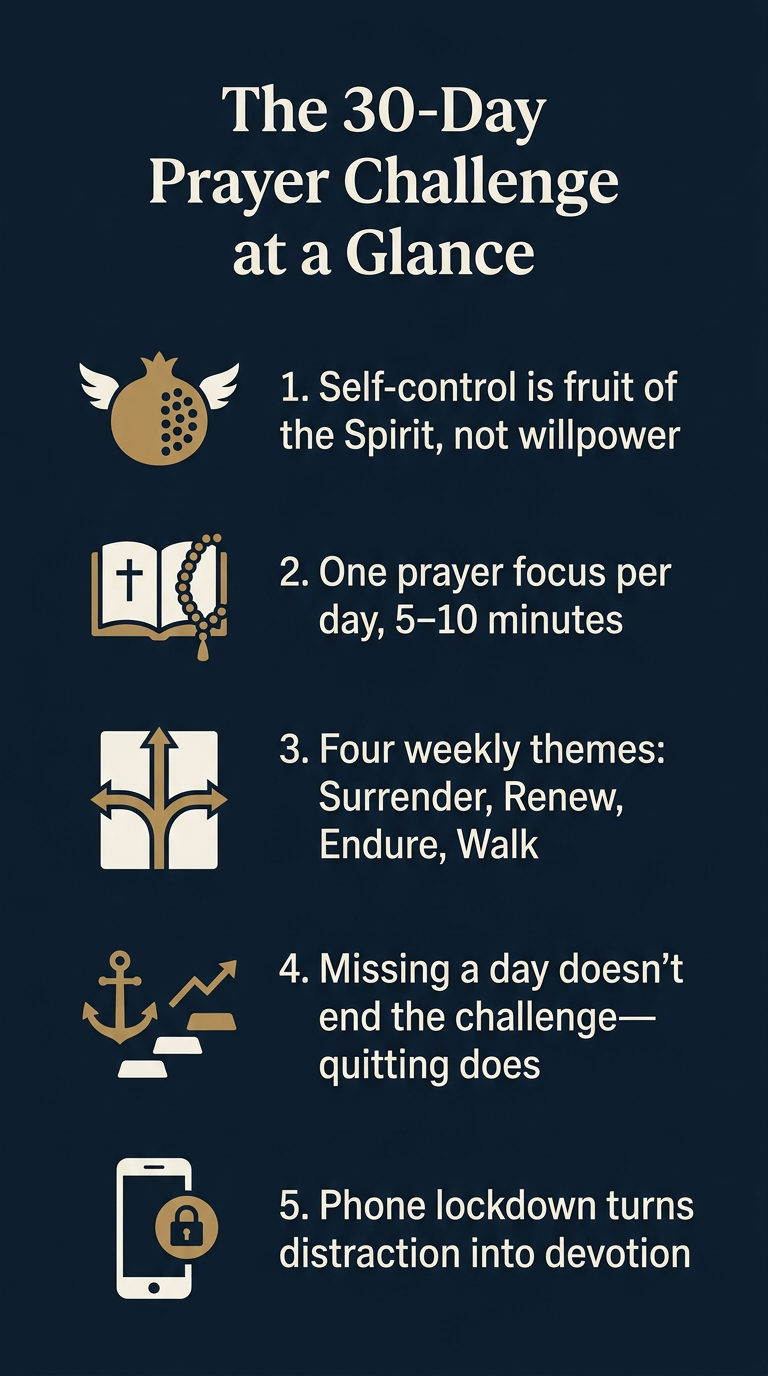
Here's the whole structure, and it's deliberately simple:
- One prayer focus per day. Not a list of twenty. One thing, prayed honestly.
- Five to ten minutes. That's it. If you have more time, great—but the bar is low on purpose.
- A themed guide. You shouldn't have to invent what to pray. Use a written prompt so you're not staring at the ceiling wondering if you're doing it right.
- Same time, same place. Morning works best for many people, before the day starts making demands. If you've never tried a fixed prayer time, start there.
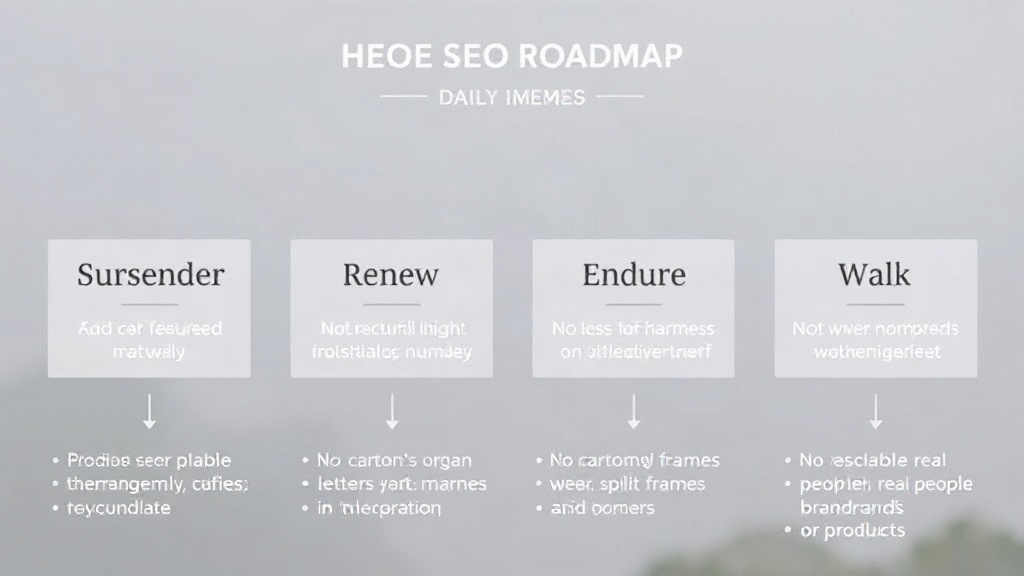
Four weeks, four themes: Surrender, Renew, Endure, Walk. Each week builds on the last. You're not trying to fix everything by Friday.
This is where your phone stops being the enemy and starts being the tool. Light Keeper locks distracting apps until you've completed your daily prayer. You tap the app, you pray, the phone unlocks. That's the whole trick—your biggest source of temptation becomes the thing that gets you to your knees.
Week 1: Surrender – Acknowledging You Can't Do It Alone
The first week is about getting honest. Not fixing. Not promising. Just telling God the truth about where you actually are.
Days 1-7 prayer focus:
- Day 1 — Confess that you've been trying to change in your own strength.
- Day 2 — Ask the Spirit to show you the one area of your life most out of control.
- Day 3 — Pray for a willing heart, even if you don't feel like it yet.
- Day 4 — Thank God that His strength is made perfect in your weakness (2 Corinthians 12:9).
- Day 5 — Ask for eyes to see your triggers before they spring on you.
- Day 6 — Pray for humility to admit your struggle to one trusted person.
- Day 7 — Rest. Thank God for the week. Ask Him to prepare your heart for what's next.
A sample prayer for Day 1:
Father, I've been trying to fix myself for years, and I keep failing. I'm done pretending I can white-knuckle my way into holiness. Your Word says apart from You I can do nothing—so I'm starting there. Take control of the areas I've been gripping. Grow Your fruit in me, even when I can't see it yet. In Jesus' name, amen.
Week 2: Renew – Replacing Flesh Patterns with Spirit Habits
Romans 12:2 says, "Do not conform to the pattern of this world, but be transformed by the renewing of your mind." Week 2 is about the renewing part. You're not just removing bad habits; you're installing new ones in their place. The 11 p.m. scroll slot doesn't stay empty—it fills with something. This week, you decide what that something is.
Days 8-14 prayer focus:
- Day 8 — Ask God to renew your mind in one specific area.
- Day 9 — Pray for a hunger for Scripture that outweighs your hunger for the screen.
- Day 10 — Ask for wisdom to identify your triggers (time of day, emotion, fatigue).
- Day 11 — Pray for one practical replacement habit to take hold.
- Day 12 — Ask God to make you aware of His presence in ordinary moments.
- Day 13 — Confess any self-reliance that's crept back in.
- Day 14 — Thank God for the halfway mark. Pray for endurance for week three.
Three practical moves this week:
- Phone fasting. Pick a window—say, the first thirty minutes of your day—where the phone stays face-down. Not off. Just out of reach.
- Accountability. Tell one person what you're working on. Not a group. One person who'll ask you honestly.
- Scripture memorization. Pick one verse—maybe Galatians 5:16 or Proverbs 25:28—and carry it with you. Write it on an index card. Tape it to the mirror.
Week 3: Endure – Pressing Through When You Want to Quit
This is the week most people bail. The novelty is gone, the flesh is loud, and you've probably missed a day already. Here's the truth: missing a day doesn't end the challenge. Quitting does.
Let's talk about what the slump actually feels like, because nobody warns you about it. Around day 16 or 17, prayer starts feeling like a chore. The same words, the same chair, the same five minutes—and your brain starts whispering that this isn't working, that you're just going through the motions, that real Christians don't have to force themselves to pray. Haha, we've all been there. That voice is not the Spirit. The Spirit convicts; the flesh condemns. If the voice is telling you to quit, it's not from God.
What do you do when you miss a day? Simple: don't miss two. Pick up where you left off. God isn't grading on attendance. He's growing fruit, and fruit doesn't grow on a schedule you control. If you need to hear more about why we built an app around grace instead of guilt, the story of two brothers who built this thing is worth a read.
Days 15-21 prayer focus:
- Day 15 — Pray for perseverance when you don't feel like praying.
- Day 16 — Confess any failure honestly, without excuses and without despair.
- Day 17 — Ask God to remind you that grace covers missed days.
- Day 18 — Pray for strength to resist your biggest temptation today.
- Day 19 — Ask for a friend to walk with you through the rest of the challenge.
- Day 20 — Thank God for progress, not perfection.
- Day 21 — Pray for joy to return, even in the hard middle.
Week 4: Walk – Making Self-Control a Lifelong Rhythm
Galatians 5:25 says, "Since we live by the Spirit, let us keep in step with the Spirit." That phrase—keep in step—describes a walk, not a sprint. Week 4 is about turning thirty days into a lifetime.
Days 22-30 prayer focus:
- Day 22 — Ask God to make this a rhythm, not a one-time event.
- Day 23 — Pray for joy in obedience, not just duty.
- Day 24 — Ask for grace to extend the habit past day 30.
- Day 25 — Pray for the people around you to notice the change.
- Day 26 — Ask God to show you the next area He wants to grow.
- Day 27 — Thank Him for every day you showed up, even the messy ones.
- Day 28 — Pray for a plan for month two.
- Day 29 — Ask for a heart that keeps seeking Him after the challenge ends.
- Day 30 — Celebrate. Then start again.
If you want a broader set of resources to keep going, our blog has plenty of material for the road ahead.
Practical Tips to Make the Challenge Stick
- Set a fixed time. Morning, before the phone, before the coffee, before the kids. If it's not scheduled, it's not happening.
- Use a prayer app that blocks distractions. This is the one that changes everything. Light Keeper locks the apps you choose until you've prayed. Your phone becomes a gatekeeper for your own good.
- Track your streak. Many people find real power in not wanting to break the chain. Our app tracks consistency so you can see the pattern.
- Find a prayer partner. One person. Weekly check-in. That's it.
- Celebrate small wins. Made it seven days? Text your prayer partner. That's not pride; that's fuel for day eight.
Here's how common struggles map to specific prayer focuses:
| Struggle | Common Pattern | Prayer Focus |
|---|---|---|
| Phone scrolling | Reaching for the screen when bored or anxious | Presence — asking God to meet you in the quiet |
| Anger / short temper | Flaring when expectations aren't met | Surrender — releasing control of outcomes |
| Overeating | Eating for comfort rather than hunger | Satisfaction — finding fullness in Christ |
| Lust | Desires drifting from God's design | Purity — asking for a renewed heart (Matthew 5:8) |
| Laziness | Avoiding tasks that feel hard or risky | Diligence — praying for strength to start |
Frequently Asked Questions
What does the Bible actually say about self-control?
Self-control is listed as a fruit of the Spirit in Galatians 5:22-23, meaning it's produced by the Holy Spirit, not manufactured by willpower. Other passages like 1 Corinthians 9:24-27 and Titus 2:11-12 frame it as training under grace. The Bible treats self-control as evidence of a life yielded to God, not a personality trait.
If self-control is a fruit of the Spirit, why do I still struggle so much?
Because you still have flesh. Galatians 5:17 says the flesh and the Spirit are in active conflict. Growth is gradual, not instant. Struggling doesn't mean you're failing—it means you're in the fight. The question isn't whether you stumble; it's whether you keep showing up in prayer.
How do I start a 30-day prayer challenge without getting overwhelmed?
Start with five to ten minutes a day and one prayer focus. Don't try to overhaul your whole life on day one. Use a written guide so you're not inventing prayers on the fly, and pick a fixed time. The goal of week one is simply to show up seven days in a row.
What do I do when I miss a day or fail?
Don't miss two. Confess it, receive grace, and pick up where you left off. God isn't keeping score the way you think He is. The challenge is a tool for growth, not a test you can fail. Falling down once doesn't mean starting over—it means continuing.
How can I stop my phone from sabotaging my prayer time?
Set it face-down during your prayer window, or use an app that locks distracting apps until you've prayed. The key is making the phone work for you instead of against you.
Start Your 30-Day Prayer Challenge Today
You've read the plan. You know the framework. The only thing left is to start—and starting is where most people stall, because starting alone is hard.
Light Keeper was built for exactly this. Download it, and you'll get themed prayer guides, streak tracking, and phone lockdown that keeps the distraction out until the prayer is done. Your phone stops being the thing that pulls you away and becomes the thing that calls you back.
Thirty days from now, you'll either have another failed resolution behind you or thirty days of prayer behind you. Same effort. Very different fruit.
Download Light Keeper and start day one today.