

Overcoming Fits of Rage: How Prayer Tames the Temper (Galatians 5:20)
You blew up again. Maybe it was the third time you asked your son to put on his shoes. Maybe it was the driver who cut you off, or the email that landed at 6:45 a.m., or the group chat that wouldn't stop buzzing. And now you're sitting in the wreckage of it, the hurt face across the table, the silence in the car, wondering how a person who loves Jesus can sound like that.
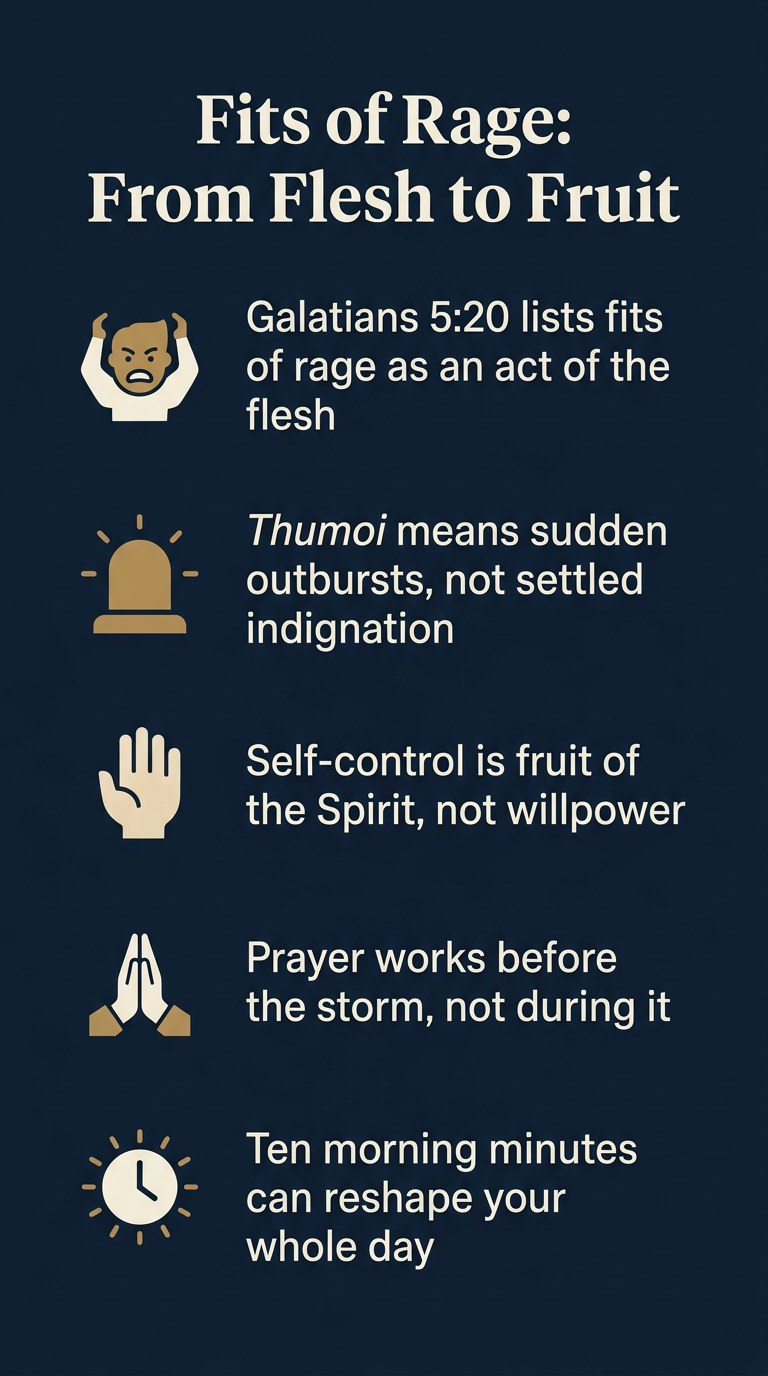
Here's the hard part: fits of rage aren't a personality quirk. In Galatians 5:20, Paul lists them right next to sexual immorality and idolatry. Not as a minor flaw, but as an act of the flesh. And fruit doesn't grow overnight. It grows slowly, in soil, over time.
In this guide:
- When the Fuse Is Short and the Spirit Feels Far
- What "Fits of Rage" Means in Galatians 5:20
- Why We Explode Over Small Things (It's Rarely the Small Thing)
- The Fruit of the Spirit Is Self-Control — Not Suppression
- Why Prayer Tames the Temper (And Where It Actually Works)
- A Practical Morning Prayer Rhythm for People With Short Fuses
- What to Do After You've Already Blown Up
- Frequently Asked Questions
- Start Tomorrow Morning Before Your Feet Hit the Floor
When the Fuse Is Short and the Spirit Feels Far
Most of us have a private theory about our anger. We think it's the exception, that the real us is patient and kind, and the yelling is what happens when circumstances push us past our limit. Paul doesn't let us off that hook.
He writes in Galatians 5:19-21 (NIV):
"The acts of the flesh are obvious: sexual immorality, impurity and debauchery; idolatry and witchcraft; hatred, discord, jealousy, fits of rage, selfish ambition, dissensions, factions and envy; drunkenness, orgies, and the like. I warn you, as I did before, that those who live like this will not inherit the kingdom of God."
Read that list again. Fits of rage sit between jealousy and selfish ambition. Paul doesn't sort sins into respectable and shameful categories. He puts the temper right in the middle of the flesh's family portrait.
And that's actually good news, because it means your anger isn't a unique, unfixable defect. It's a flesh-pattern, and every flesh-pattern in that list is broken the same way: not by gritting your teeth, but by walking in the Spirit. Which means the fix isn't a technique you master in the moment. It's a habit you build before the moment ever arrives.
What "Fits of Rage" Means in Galatians 5:20
The Greek word Paul uses is thumoi, and it's worth knowing what it doesn't mean. It doesn't describe settled, slow-burning indignation. It describes outbursts. Sudden surges of passion that flare up and boil over. The word pictures something erupting, not something reasoned.
That's the Galatians 5:20 meaning in plain terms: not "anger exists in your heart," but "anger exploded out of your mouth."
Which raises the question every honest reader asks. Is anger itself a sin? No, and Scripture is clear about that. Jesus Himself looked at the Pharisees "with anger and, being grieved by their hardness of heart" (Mark 3:5). Paul tells the Ephesians, "In your anger do not sin" (Ephesians 4:26), which assumes anger will show up.
The practical difference:
- Righteous anger is slow. It takes time to arrive because it has to pass through love for God and love for people. Fleshly rage is fast, it beats your conscience to the punch.
- Righteous anger aims at sin. Jesus was grieved by hard hearts. Fleshly rage aims at people: the child, the spouse, the driver, the coworker.
- Righteous anger grieves. It costs you something to feel it. Fleshly rage justifies itself. It feels righteous while it's happening, and only looks ugly in the rearview mirror.
If your anger is fast, aimed at a person, and self-justifying in the moment, that's not holy indignation. That's thumoi.
Why We Explode Over Small Things (It's Rarely the Small Thing)
Nobody blows up over a pair of shoes. The shoes are just the last domino. Behind them stands a row you knocked over hours, or years, earlier.

Four things are usually stacked behind the shoes:
- Unmet expectations. You had a picture of how the morning would go, and reality didn't cooperate. The gap between the two is where the heat comes from.
- Sleep debt and hunger. This isn't an excuse, but it is a fact. A tired, hungry body has less room between impulse and response. Elijah needed food and rest before he could hear God (1 Kings 19).
- Unresolved resentment. Anger that never got addressed doesn't disappear. It compounds. The tenth offense gets the interest of all nine before it.
- The phone. And this is the one we don't talk about enough.
Think about the first ten minutes of your day. For most of us, they belong to a screen. You wake up and reach for the phone before your feet hit the floor. The first thing your mind processes is a work email, a news headline, a comparison, a notification: something demanding, something urgent, something that makes you feel behind before you've had a chance to be present.
That's not a neutral way to start a day. It primes you for irritability. It hands your first thoughts to whoever sent the message. And then, three hours later, your child spills cereal and you respond like it's a crisis, because your nervous system has been in crisis since 6:45 a.m.
So here's the anxiety we need to address head-on: "I'm not an angry person. So why am I acting like one?"
Because you're not an angry person. You're a tired, distracted person who hasn't given the Spirit the first word of the day. That's a different diagnosis, and it has a different cure.
The Fruit of the Spirit Is Self-Control — Not Suppression
Now the other half of the passage. Paul continues in Galatians 5:22-23 (NIV):
"But the fruit of the Spirit is love, joy, peace, forbearance, kindness, goodness, faithfulness, gentleness and self-control. Against such things there is no law."
Notice that self-control is on the list. And notice what kind of list it is. It's fruit. Not a muscle. Not a discipline you white-knuckle your way into. Fruit.
If self-control is a muscle, then the answer to your temper is trying harder. Clench your jaw. Count to ten. Breathe. And when that fails, and it will fail, you conclude that you're simply not strong enough, and you sink a little deeper into shame.
But fruit doesn't come from effort. Fruit comes from abiding. Jesus said it plainly: "I am the vine; you are the branches. If you remain in me and I in you, you will bear much fruit; apart from me you can do nothing" (John 15:5). A branch doesn't strain to produce grapes. It stays connected to the vine, and the grapes show up.
Then verse 24: "Those who belong to Christ Jesus have crucified the flesh with its passions and desires."
Crucifixion is decisive. It's a once-for-all verdict. But it's also daily. You don't get crucified once and then live as though nothing happened. Every morning you drag the old nature back to the cross and leave it there.
So the goal shifts. It's not "manage my anger better." It's "walk in the Spirit, and let Him grow His fruit in me." Those are two different projects, and only one of them works.
Why Prayer Tames the Temper (And Where It Actually Works)
Prayer does not lower your blood pressure in the moment of the outburst. If you're mid-argument and you try to pray your way calm, you'll usually find you can't even focus. The fuse is already lit.
Prayer works before the storm. It does three specific things:
- It sets the day's first allegiance. Whoever gets your first attention gets your default posture. If the phone gets it, you spend the day reacting. If God gets it, you spend the day responding.
- It reorients your identity. Most rage is a defense of self: my time, my plans, my dignity. Prayer reminds you who you actually are: a beloved child, already secure, with nothing to defend.
- It trains you to hear the Spirit's nudge. The window between provocation and outburst is about two seconds. Nobody learns to obey in two seconds. But a person who has spent twenty minutes in prayer that morning has been practicing attentiveness all day.
The difference is stark:
| In-the-moment techniques | Before-the-storm prayer habits | |
|---|---|---|
| When it operates | After the trigger, in the heat | Before the trigger, in the quiet |
| What it changes | The volume of your response | The condition of your heart |
| What it relies on | Willpower and self-awareness | The Spirit's fruit growing in you |
| How it holds up when tired | Poorly, willpower depletes | Better, it's a habit, not a decision |
| What it produces over time | Managed behavior | Actual transformation |
| Failure mode | Shame spiral when it doesn't work | Return to the cross and start again |
Use both. Take a breath in the moment. But don't expect the breath to do what only the Spirit can.
A Practical Morning Prayer Rhythm for People With Short Fuses
You don't need an hour. You need the first ten minutes of your day, before the phone.

Here's a pattern that fits a real life:
1. Before you touch the screen (minutes 1-2). Get up, get water, sit down. Don't check anything. Your first words are not to your inbox; they're to your Father.
2. Name the day's likely flashpoints (minutes 2-4). This isn't unspiritual. It's wisdom. You already know where the pressure will come. The school run at 7:40. The 3 p.m. meeting with the person who talks over you. The group chat that always goes sideways. Name them out loud.
3. Pray specifically over each one (minutes 4-8). Not "help me be patient today," but: "Lord, when she interrupts me in that meeting, let me be slow to speak. When the kids fight in the back seat, let me respond like a father and not like a referee with a short fuse."
4. Ask for the fruit (minutes 8-10). Pray Galatians 5:22-23 back to God. "Produce Your fruit in me today: patience, gentleness, self-control. I can't manufacture it. Grow it."
A short prayer you can borrow:
Father, I'm giving You the first minutes of this day. I don't know everything that will come at me, but You do. Guard my mouth. Guard my temper. When I'm provoked today, remind me who I am in Christ: someone with nothing to prove and nothing to defend. Grow Your fruit in me. In Jesus' name, amen.
Now, what happens when you miss a morning? Haha, we've all been there. The alarm doesn't go off, the baby wakes up early, or you just grab the phone out of habit before you remember. Here's the thing: missing one morning doesn't mean the day is lost. The Spirit isn't waiting for a perfect streak. What matters is what you do at the next quiet moment. Maybe it's a two-minute prayer in the car before you walk into work. Maybe it's a whispered "Lord, guard my mouth today" while the coffee brews. The goal isn't a perfect record. It's a soft heart that keeps returning.
And here's the practical fence. The reason most people never build this habit isn't that they don't want to. It's that the phone wins the first fifteen minutes by default. That's exactly the problem Light Keeper was built to solve: it locks your phone until your daily prayer is complete. Not as a gimmick, but as a fence around the soil where fruit grows. You can read more about the theology behind the app if you want the thinking behind it.
What to Do After You've Already Blown Up
You will still blow up sometimes. The question is what you do next.
Here's what not to do: spiral. Self-flagellation feels like repentance, but it isn't. It's just shame wearing spiritual clothes. It keeps your eyes on yourself instead of on Christ, and it produces nothing but discouragement.
"If we confess our sins, he is faithful and just and will forgive us our sins and purify us from all unrighteousness" (1 John 1:9). That's the promise. Confess, receive, move on.
And then go apologize. Specifically. Here's a short script that works with a spouse or a child:
- Name the sin plainly. "I lost my temper with you. That was sin, and it was wrong."
- Don't blame-shift. Not "I'm sorry, but you know how you get." Not "I'm just tired." Just own it.
- Ask for forgiveness. "Will you forgive me?" Let them answer.
- Don't over-promise. Don't say "I'll never do it again." Say "I'm asking God to change me, and I'm sorry I hurt you."
- Repair where you can. If you broke something, fix it. If you embarrassed them publicly, apologize publicly.
Your kids are watching how you handle your failures more than they're watching how you handle your successes. A parent who repents well teaches their children something a perfect record never could.
Frequently Asked Questions
Is anger itself a sin?
No. Jesus Himself was angry (Mark 3:5), and Paul assumes believers will experience anger without sinning (Ephesians 4:26). The sin is what you do with it. See the distinction above: the difference is speed, target, and whether it grieves or justifies.
What does the Bible say about losing your temper?
Scripture consistently warns against it. "Fits of rage" appear in Paul's list of fleshly acts in Galatians 5:19-21, alongside sexual immorality and idolatry. James 1:19-20 tells us human anger does not produce God's righteousness.
How do I pray when I'm already angry?
Honestly. You don't need polished words. Tell God the truth: "I'm furious right now, and I don't want to be." Even that is prayer. But the most effective prayer for anger is the one you prayed that morning, before the provocation came.
Can a Christian struggle with anger and still be saved?
Yes. The presence of struggle is evidence of the Spirit at work: dead things don't fight. Paul describes the Christian life as a battle between flesh and Spirit (Galatians 5:17). What Scripture warns against is not struggling with anger but living in it without repentance. Keep returning to the cross.
How long does it take to change?
Longer than you want, shorter than you fear. Fruit grows in seasons, not in a single afternoon. Most people notice real change in months of consistent morning prayer, not days. The goal isn't a perfect record. It's a soft heart that keeps coming back.
Start Tomorrow Morning Before Your Feet Hit the Floor
Here's your one decision: tomorrow morning, before you touch the phone, pray. Ten minutes. Name your flashpoints. Ask for the fruit. Give God the first word of the day.
That's the whole plan. Not a technique for the moment of rage, but a fence around the soil where self-control grows. If you want help building that fence, Light Keeper locks your phone until your daily prayer is done, so the first fifteen minutes of your morning belong to God instead of your inbox. You can learn more about the app and the brothers who built it, or download it and start tomorrow.
If you want to keep digging into what Scripture says about the fruit of the Spirit and the acts of the flesh, our blog is a good next stop.
May the Lord make you slow to speak, slow to become angry, and quick to return to Him. He is faithful to finish what He started in you.