

The Sin of Selfish Ambition: Praying for a Servant's Heart (Galatians 5:20)
If you've ever read Galatians 5 and felt the sting of two words — selfish ambition — you're in good company. Paul slips it into a list that includes sexual immorality and drunkenness, and most of us skim right past it until we realize it describes us. The Greek word behind it, eritheia, isn't about having drive. It's about rivalry, self-promotion, and the quiet war to be seen. It shows up in the group chat, in the prayer request you phrase just so, and in the volunteer slot you'd rather have. The good news is that the same passage that names the problem also names the cure — and it starts with prayer.
In this guide:
- What Selfish Ambition Means in Galatians 5:20
- Is Ambition a Sin? The Difference Between Drive and Selfish Ambition
- Where Selfish Ambition Actually Shows Up in Daily Life
- Why Paul Puts Selfish Ambition Next to Sexual Immorality and Drunkenness
- The Fruit of the Spirit Is the Antidote: Love, Joy, Peace, and Self-Control
- How to Pray for a Servant's Heart (Without Becoming a Doormat)
- Building a Daily Habit of Praying for Humility
- Frequently Asked Questions
- Start Tomorrow Morning With a Prayer for a Servant's Heart
What Selfish Ambition Means in Galatians 5:20
Paul writes in Galatians 5:19-21 (NIV):
The acts of the flesh are obvious: sexual immorality, impurity and debauchery; idolatry and witchcraft; hatred, discord, jealousy, fits of rage, selfish ambition, dissensions, factions and envy; drunkenness, orgies, and the like. I warn you, as I did before, that those who live like this will not inherit the kingdom of God.
Paul doesn't call these moods or tendencies. He calls them acts — things you do, things other people can see. Selfish ambition belongs in that category. It's not a feeling that washes over you; it's a pattern of behavior you choose, often without noticing you've chosen it.
The Greek word translated "selfish ambition" is eritheia. In secular Greek it described a hired worker campaigning for office, someone who would say anything to win a position. It carried the sense of self-seeking through rivalry — a man who wants the prize more than he wants the truth. The word appears again in Philippians 2:3, where Paul tells the church, "Do nothing out of selfish ambition or vain conceit. Rather, in humility value others above yourselves."
So the meaning is not mysterious. Selfish ambition is the drive to advance myself at the expense of others, or at least without regard for them. It's the flesh doing what the flesh always does: putting me at the center and calling it normal.
Is Ambition a Sin? The Difference Between Drive and Selfish Ambition
No — ambition itself is not a sin. Paul tells the Thessalonians to "make it your ambition to lead a quiet life: You should mind your own business and work with your hands" (1 Thessalonians 4:11). He tells slaves in Colossians 3:23, "Whatever you do, work at it with all your heart, as working for the Lord, not for human masters." Working hard, wanting to do well, striving for excellence — these are good. God gave you your abilities, and He expects you to use them. This sin isn't reserved for politicians and CEOs, either. It's an ordinary temptation for ordinary believers.
The line is not between ambition and laziness. It's between ambition aimed at God's glory and ambition aimed at my own. When the person who beat you to the role walks in, what does your face do before your mouth catches up? That's the test.
- At work. You want the promotion because the work matters and you'd do it well, and you're genuinely glad when a coworker gets it instead. That's drive. You want the promotion because you can't stand the thought of him getting it. That's eritheia.
- At church. You teach the adult class because you love the Word. That's a good desire. You teach the adult class because you want people to think of you as the teacher. That's the flesh wearing a Sunday shirt.
- At home. You serve your family because you love them. Or you serve them and keep a mental ledger of who owes you. Same actions, different engine.
- Online. You share a verse to encourage someone. Or you share it and check the likes three times in an hour. The post is identical. The heart isn't.
Where Selfish Ambition Actually Shows Up in Daily Life
This is where the Bible gets uncomfortable, because the sin rarely announces itself. It hides in respectable places. Here are a few I've caught in my own life, and I suspect you'll recognize at least one:

- You phrase a prayer request so the group understands how much you're carrying — and how well you're carrying it.
- You volunteer for the role people will notice and quietly hope someone else handles the setup and the cleanup.
- You check who viewed your story, who liked the post, who replied to your message — and you feel a small drop in your stomach when the number is low.
- You replay a conversation in your head, not to understand the other person, but to win it this time.
- You measure your spiritual life against the person next to you in the pew — and feel either superior or defeated, never simply grateful.
- You serve your spouse or your kids, then mention it later. Not as a boast. Just so it's known.
- You feel a flicker of resentment when someone else's ministry takes off.
That last one is the tell. Eritheia always produces rivalry, and rivalry always produces that flicker. If you can name a person whose success irritates you, you've found the exact spot where the flesh is still alive. That's not a reason to despair. It's a reason to pray — specifically, for that person's good.
Why Paul Puts Selfish Ambition Next to Sexual Immorality and Drunkenness
This is the objection most of us feel. Really? Selfish ambition in the same list as drunkenness? That seems harsh.
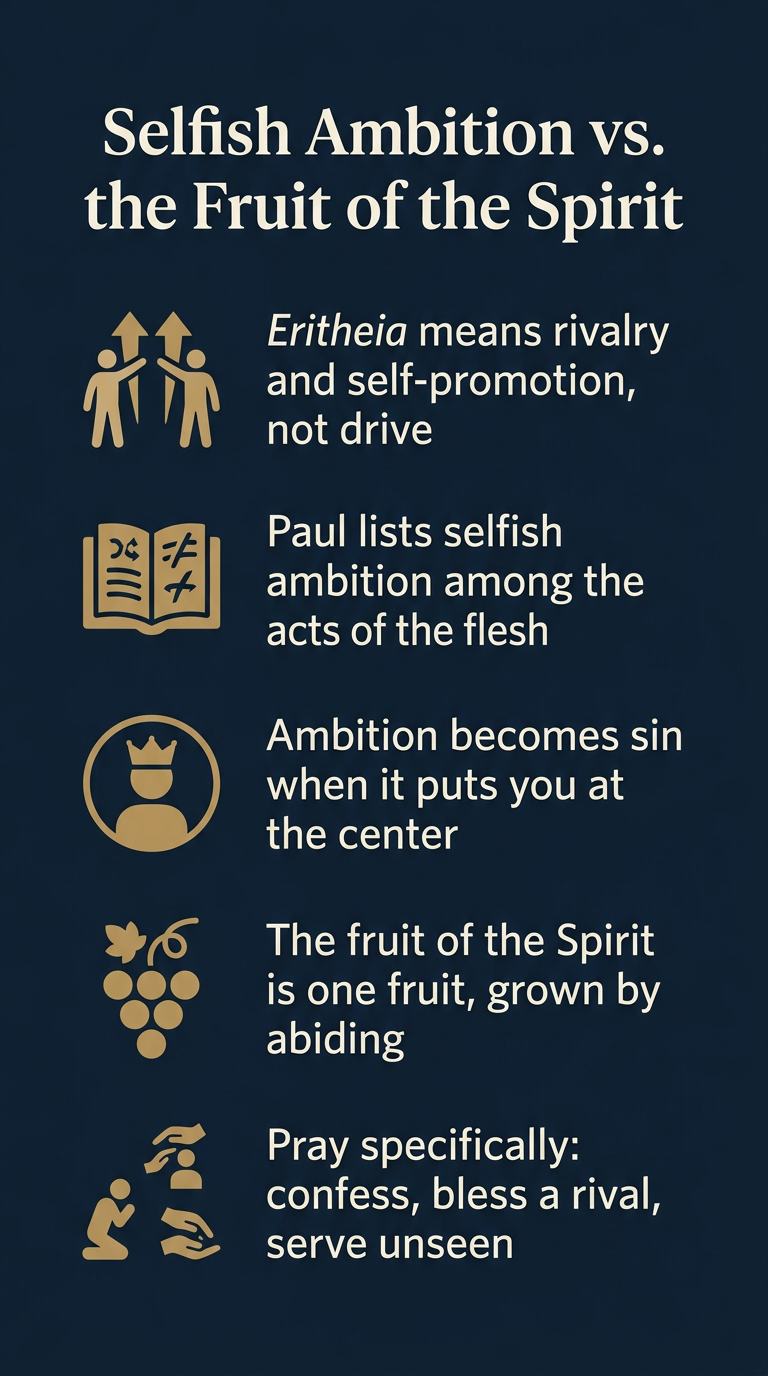
But look at how Paul frames the whole passage. He says the acts of the flesh are obvious. He's not giving us a ranking. He's telling us that the flesh doesn't only produce scandalous sins — it produces respectable ones too. Sexual immorality ruins a body. Selfish ambition ruins a church. Both grieve the Spirit. Both are the flesh doing what the flesh does.
Think about what eritheia actually does in a congregation. It splits small groups. It turns ministry into a competition. It produces the "dissensions" and "factions" Paul lists two words later, right after it. Selfish ambition is the root; division is the fruit. A man who wants to be right more than he wants his brother restored will tear a church apart, and he'll do it while quoting Scripture.
And Paul's warning in verse 21 is sober: "I warn you, as I did before, that those who live like this will not inherit the kingdom of God." He's not saying a single selfish thought costs you your salvation. He's saying a life characterized by self-promotion is evidence that the Spirit isn't ruling it. That's the same logic as 1 John — the fruit reveals the root. If your Christianity is mostly a platform, the warning is for you. Not to condemn you. To wake you up.
The Fruit of the Spirit Is the Antidote: Love, Joy, Peace, and Self-Control
Paul doesn't leave us in the warning. Two verses later:

But the fruit of the Spirit is love, joy, peace, forbearance, kindness, goodness, faithfulness, gentleness and self-control. Against such things there is no law. Those who belong to Christ Jesus have crucified the flesh with its passions and desires. (Galatians 5:22-24, NIV)
Look at how directly each fruit opposes eritheia:
- Love wants the other person's good, not just my own. It's the exact opposite of rivalry.
- Joy doesn't need the credit. It's content in the work itself.
- Peace doesn't need to win the argument. It can let a point go.
- Forbearance puts up with being overlooked.
- Kindness serves without a ledger.
- Goodness does the right thing when no one is watching.
- Faithfulness keeps showing up in the unseen role.
- Gentleness handles people like they matter more than my reputation.
- Self-control is the one that hits hardest. It's the Spirit's answer to the flesh's appetite — including the appetite for attention.
Paul calls this fruit, not fruits. It's one thing growing on one tree. You don't grit your teeth and manufacture self-control. You abide, and the Spirit produces it. Which means the work of killing selfish ambition isn't primarily a self-improvement project. It's a surrender project. Verse 24 says those who belong to Christ "have crucified the flesh" — past tense, done at conversion, and worked out daily for the rest of your life. Verse 25 says, "Since we live by the Spirit, let us keep in step with the Spirit." That's a walk, not a sprint.
How to Pray for a Servant's Heart (Without Becoming a Doormat)
Praying for a servant's heart does not mean praying to become a doormat. Jesus washed His disciples' feet — and He also flipped tables in the temple and called the Pharisees whitewashed tombs. Servanthood is not passivity. It's strength aimed in a different direction. A servant's heart means you're free to serve because you're not depending on people's approval anymore. You can say hard things, hold boundaries, and lead well, because you're not doing it for the applause.
A simple pattern you can pray in about two minutes. Four movements: confess, ask, look, and rejoice.
1. Confess specifically. Not "forgive me for my pride" — name it. "Lord, I wanted that promotion more than I wanted You to be glorified. I wanted the credit for the thing I did last week. I felt that flicker when she got the recognition and I didn't. That's the flesh. I'm sorry."
2. Ask for one specific person's good. Pick the person whose success bothers you most. Pray for them by name, out loud, for thirty seconds. This is the most direct thing Scripture gives us for killing rivalry — Jesus told us to pray for those who persecute us, and that includes the person who got the role you wanted. It's hard to keep resenting someone you're genuinely asking God to bless.
3. Ask to see the unseen work. "Lord, show me what needs doing today that no one will notice. Give me joy in it." Then do the thing. Take out the trash at church. Text the discouraged friend. Do the task your spouse always does and never mention it.
4. Ask for joy in being overlooked. This is the hardest one, and the most freeing. "Father, I want to be content when no one sees. You see."
A short sample prayer, in your own voice:
Lord, You know how much I want to be noticed. I confess that. I've been building my own kingdom and calling it ministry. Today, I'm handing it back. Bless [name] — genuinely, Lord, bless them. Show me the work that no one will see, and let me do it with joy. Make me a servant like Your Son, who washed feet and didn't need a single person to say thank You. Amen.
Building a Daily Habit of Praying for Humility
The flesh doesn't die in one sitting. You can pray that prayer with real tears on Sunday and be checking your follower count by Tuesday. That's not a reason to give up. It's a reason to make it a habit.
The humility prayer only works if it actually happens — and the reason most of us don't pray consistently isn't that we don't want to. It's that we're lying in bed with a phone in our hand before we've said a word to God. The first thing we do every morning is scroll. We've handed the first fifteen minutes of our day, and often the first fifteen thoughts, to the flesh.
This is exactly why we built Light Keeper. The app locks your phone until you've completed your daily prayer. You wake up, you tap the lamp, and the phone won't unlock until you've actually prayed. It's built on the parable of the ten virgins — the idea that faithful, daily, boring obedience is what keeps the lamp burning. You can read more about the idea behind the app if you want the theology behind it, or read why two brothers built it if you want the story.
It's a fence, not a magic trick. If you're going to pray for a servant's heart every day, you need a structure that makes the prayer happen before the phone wins. You can learn more about who we are — we're Protestant, Baptist in theology, and we don't mess with saints or mysticism. Just Scripture, the Spirit, and the ordinary work of dying to self.
If you want to keep thinking about the fruit of the Spirit, our blog has more on prayer and the daily walk.
Frequently Asked Questions
Is selfish ambition a sin, or just a personality trait?
It's a sin — Paul lists it among the acts of the flesh in Galatians 5:20. But it's a sin with a specific shape: self-promotion through rivalry. Having a strong personality, being competitive, or wanting to excel is not the same thing. The sin is when your drive puts you at the center and treats other people as obstacles or audiences.
What's the difference between ambition and selfish ambition?
Ambition asks, "Can I do this well for God and others?" Selfish ambition asks, "Will this make me look good?" Both can produce identical actions — the same promotion, the same ministry role, the same post. The difference is the audience you're playing to. Ambition serves a purpose; selfish ambition serves a person: you.
Why does Paul list selfish ambition with sexual immorality and drunkenness?
Because the flesh produces respectable sins too. Selfish ambition splits churches and destroys friendships, which is why Paul lists "dissensions" and "factions" right after it. The warning in verse 21 isn't a ranking. It's a reminder that a life ruled by self-promotion shows the Spirit isn't ruling it.
Can I pray for a servant's heart without becoming a doormat?
Yes. Jesus washed feet and flipped tables. A servant's heart isn't weakness — it's freedom from needing approval. You can serve, set boundaries, speak hard truths, and lead well, all because your identity isn't riding on other people's opinions. Servanthood is strength aimed at others' good instead of your own glory.
How do I start praying for humility every day?
Start small and consistent. Pick a fixed time — ideally first thing in the morning, before your phone. Use a simple pattern: confess specifically, ask for one person's good, ask to see the unseen work, and ask for joy in being overlooked. Five minutes is enough. The point isn't length. It's that it actually happens.
Start Tomorrow Morning With a Prayer for a Servant's Heart
Tomorrow morning, before you check a single notification, pray. Confess the ambition. Bless the person you'd rather beat. Ask God to make you the kind of servant who does the unseen work with joy.
And if you know yourself well enough to know the phone will win, let us help. Light Keeper locks your phone until you've finished your daily prayer. It's a small fence around the most important fifteen minutes of your day. Download the app, pick your prayer, and start tomorrow with your lamp burning — not your feed refreshing.