

The Fruit of Gentleness: How Daily Prayer Softens a Hard Heart
You snapped again this morning. Maybe it was the third time you asked your son to put on his shoes, or the tone your spouse used when they asked about the dishes. The words were out before you thought about them, and thirty seconds later you were standing in the kitchen with that familiar heaviness in your chest.
Gentleness is not a personality type you either got or didn't. It's fruit of the Spirit — and fruit grows slowly, in soil, over seasons. Most believers who struggle with a sharp tongue don't need a stronger resolve. They need a different first five minutes of their day.
In this guide:
- What the Bible Means by Gentleness (It's Not Weakness)
- Fits of Rage: The Flesh's Most Familiar Fruit
- Why Your Phone Makes You Quicker to Snap
- How Daily Prayer Actually Softens a Hard Heart
- What Gentleness Looks Like on a Tuesday Morning
- When You Fail: Grace for the Morning You Snapped Anyway
- Building a Streak of Gentleness, One Morning at a Time
- Frequently Asked Questions
What the Bible Means by Gentleness (It's Not Weakness)
The Greek word Paul uses in Galatians 5:23 is prautēs. It's the same word used of a wild horse that has been broken in — not weakened, but trained. The strength is still there. It's just under control now, responsive to the rider's hand.
That's the picture. Gentleness is not the absence of power. It's power that answers to a different master.
Look at how Jesus described Himself in Matthew 11:29: "Take my yoke upon you and learn from me, for I am gentle and humble in heart." This is the same Jesus who flipped tables in the temple and called the Pharisees whitewashed tombs. He was not a pushover. He was never out of control. His strength was always aimed, never spilled.
Paul tells the Philippians, "Let your gentleness be evident to all. The Lord is near" (Philippians 4:5). Notice the logic. The reason you can be gentle is that the Lord is near — you're not carrying the situation alone, so you don't have to force it.
So when your coworker takes credit for your work, gentleness isn't pretending it didn't sting. It's choosing a response that doesn't require you to win the moment. That's not weakness. That's a strong person who has learned to trust Someone else with the outcome.
Fits of Rage: The Flesh's Most Familiar Fruit
Paul doesn't soften this. In Galatians 5:19-21 he writes:
The acts of the flesh are obvious: sexual immorality, impurity and debauchery; idolatry and witchcraft; hatred, discord, jealousy, fits of rage, selfish ambition, dissensions, factions and envy; drunkenness, orgies, and the like. I warn you, as I did before, that those who live like this will not inherit the kingdom of God.
Read that list again. "Fits of rage" sits between jealousy and selfish ambition. Paul puts losing your temper in the same category as the sins we'd never dream of excusing. That's uncomfortable, and it's meant to be.
The part that matters: Paul calls these acts of the flesh. Not "personality quirks." Not "the way I was raised." Not "just who I am." Rage is a habit your flesh has learned, and habits can be unlearned — but only by a different power.
"But am I even saved if I keep doing this?"
This is the question most people are too embarrassed to ask out loud, so let's ask it plainly.
Paul is describing a pattern of life, not a moment of failure. He says "those who live like this." A believer who loses their temper and hates it — who grieves over it, confesses it, and wants to change — is not living in rage. They're fighting it. That fight is itself evidence the Spirit is at work.
The person who is truly in danger is the one who has stopped caring. If it still bothers you, that bother is a gift. It means the Spirit hasn't given up on that corner of your heart, and neither should you.
Why Your Phone Makes You Quicker to Snap
Your temper lives in a body, and that body has habits. Think about the last hour before you fell asleep last night. Were you reading Scripture, or were you scrolling? Most of us know the answer.
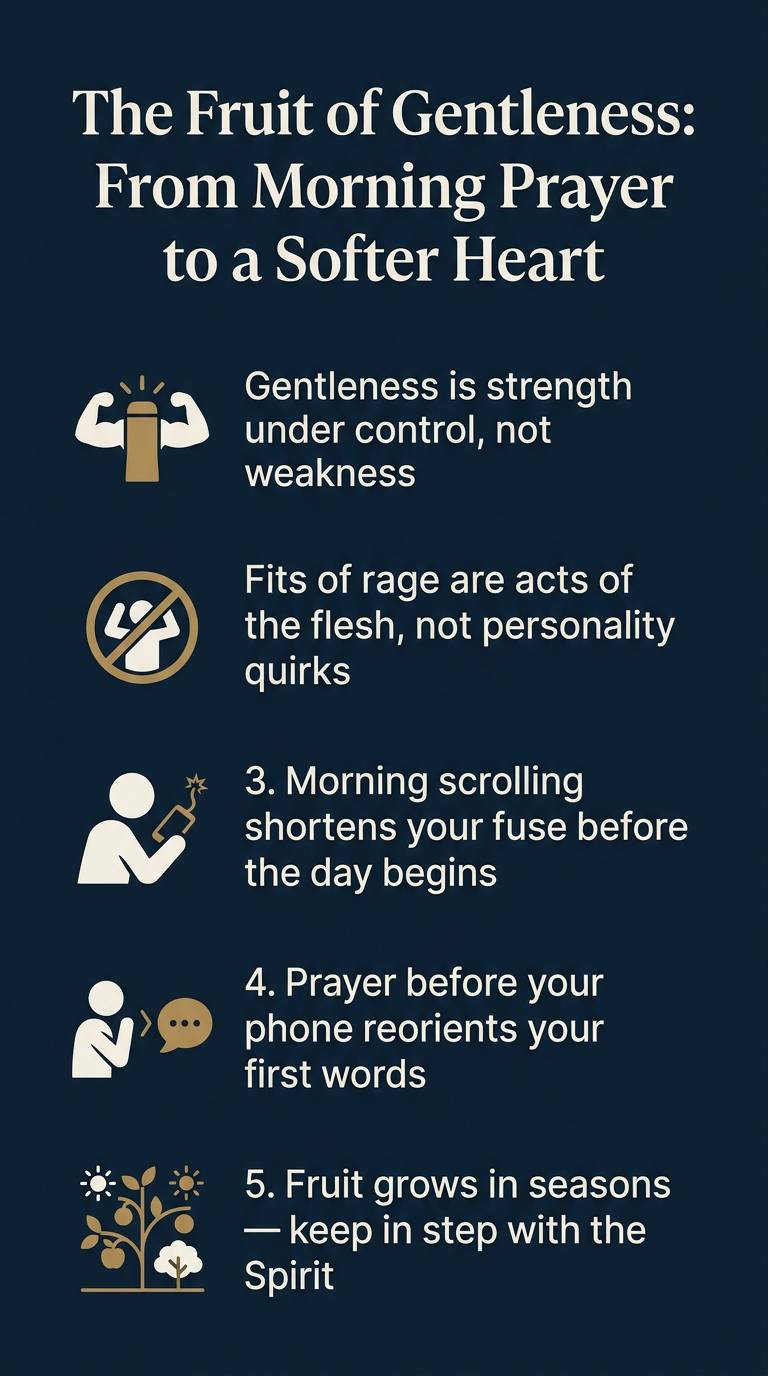
That scroll does real work on you:
- It shortens your fuse before the day starts. You've already consumed forty opinions, three arguments, and someone's vacation photos before you've said good morning to God.
- It trains you to expect instant answers. Every tap delivers. So when your four-year-old takes ninety seconds to respond, your nervous system reads it as an outrage.
- It puts you in the inbox before you're in the Word. The first email you read sets the emotional tone for the next several hours. You're handing that job to whoever happened to message you first.
- It fragments your attention. Divided attention is irritable attention. You can't be present with your family while half your mind is on a notification.
We built Light Keeper because we lived this. Two brothers, both convicted that our phones had quietly become the first thing we worshipped each morning. Not in a dramatic, idol-in-the-living-room way — just in the ordinary way that whatever gets your first minutes gets your heart. The story behind why we built it gets into the details.
The physical fix is embarrassingly simple: your phone doesn't unlock until your prayer is done. Not because an app makes you holy, but because your flesh needs a fence around the thing it keeps running to.
How Daily Prayer Actually Softens a Hard Heart
Prayer doesn't soften your heart by magic. It softens it by reorienting the first minutes of your day, before the world gets a vote.

Think about what happens when you pray before you check anything:
You speak to God before you speak to anyone else. Your first words of the day are worship, not a complaint or a reply. That sets a tone your flesh has to work against for the rest of the day.
You put Scripture in front of your eyes before you put a screen there. The verses you read at 6:45 are still in your head at 8:15 when your kid spills the milk.
You hand your day over before you try to control it. Most of our rage comes from a quiet belief that everything depends on us. Prayer says out loud that it doesn't.
Jesus told a parable about this in Matthew 25 — the ten virgins waiting for the bridegroom. Five had oil for their lamps. Five didn't, and they ran out at the worst possible moment. The oil didn't fill itself. It had to be gathered, day by day, before it was needed.
That's the whole picture. Your gentleness at 7:30 a.m. is drawn from the oil you gathered at 6:45. If you skip the gathering, don't be surprised when the lamp is dry. You can read more about the oil lamp and the ten virgins if that image resonates.
What Gentleness Looks Like on a Tuesday Morning
7:12 a.m. The shoes are still not on. Your spouse asks a question you've answered three times. The text you drafted last night is still sitting in your drafts folder.

Gentleness, as fruit of the Spirit, looks like:
- A slow answer instead of a sharp one. You breathe, and you answer a fourth time without the edge.
- A soft tone with a toddler at 7 a.m. The shoes aren't on. They won't be on for another four minutes. You kneel down and help instead of barking from the doorway.
- A text you don't send. You drafted it. It was good. You delete it and pray for the person instead.
- A question instead of an accusation. "What's going on with you today?" lands differently than "Why are you being like this?"
- A delayed reaction. You feel the heat rise and you say, "Give me a minute." Then you take the minute — and pray in it.
- An apology that doesn't include a defense. "I was harsh. I'm sorry." Full stop. No "but you…"
If you can do one of these today, you've practiced the fruit.
When You Fail: Grace for the Morning You Snapped Anyway
You will snap again. Probably this week.
That doesn't mean the process failed. It means you're a branch on a vine, and branches don't produce fruit overnight. An apple tree doesn't apologize for being bare in April. It just keeps growing.
Paul writes in Galatians 5:24-25:
Those who belong to Christ Jesus have crucified the flesh with its passions and desires. Since we live by the Spirit, let us keep in step with the Spirit.
"Keep in step." That's a walking pace, not a sprint. The image is a person matching their stride to someone walking beside them — adjusting, correcting, catching up when they fall behind. You will fall behind. You will catch up. That's what walking looks like.
On the morning you fail:
- Confess it specifically. Not "I'm sorry I got frustrated." Name it: "I was cruel to my daughter."
- Receive the forgiveness. 1 John 1:9 is not a suggestion. If you confess, He forgives. Refusing to accept that is its own kind of pride.
- Make it right with the person. A quick, honest apology repairs more than you think.
- Get back to the routine tomorrow. The streak matters more than any single day.
Fruit grows over seasons. Give the Spirit a season.
Building a Streak of Gentleness, One Morning at a Time
A streak is just a chain of small obediences. One morning of prayer before your phone. Then another. Then a week of them, and you start to notice the reflex changing — the pause before the snap gets a little longer.
That's how we built Light Keeper. We didn't start with a theology of gentleness. We started with the realization that we were checking our phones before we were checking in with God, and that it was making us worse men. So we made a rule for ourselves: no phone until prayer is done. Then we made it an app, because willpower alone lost that fight about nine times out of ten.
The app keeps your phone locked until you complete your daily prayer, and it tracks your streak so you can see the pattern over weeks, not just today. That's it. The rest is just showing up.
The connection to gentleness isn't mystical. It's mechanical. You are training a reflex. Every morning you pray before you scroll, you're teaching your body that God gets the first word — and your family gets the second, not the leftovers. If you're new here, our about page explains the ministry and the theology underneath it.
Start tomorrow morning differently. Download Light Keeper and let your first five minutes belong to God — before your phone gets a single one of them.
Frequently Asked Questions
Is gentleness the same as being a pushover?
No. Biblical gentleness is strength under control, not the absence of strength. Jesus was gentle and He also drove money changers out of the temple. A gentle person can still say hard things, set boundaries, and confront sin — they just do it without cruelty and without losing control of themselves.
I keep losing my temper. Does that mean the Holy Spirit isn't really in me?
No. 1 John 3:19-20 says, "If our hearts condemn us, we know that God is greater than our hearts." The very fact that you're convicted and grieved by your anger is evidence the Spirit is at work in you. A dead conscience doesn't feel anything. A living one feels the sting — and that sting is proof of life, not proof of absence.
What's actually happening in my brain when prayer changes my temper?
Your temper runs on a habit loop: trigger, response, reward. Every time you snap, you strengthen that neural pathway. When you pray first thing in the morning, you're interrupting the loop before it starts and building a competing pathway — one where a slow breath and a silent prayer become the default response. It's not magic. It's the same mechanism that forms any habit, pointed at the Spirit's fruit instead of the flesh's.
How long does it take before gentleness feels natural?
Longer than you'd like, and that's normal. Fruit grows in seasons, not days. Most people notice small changes within a few weeks of consistent prayer, but the deeper shifts take months. The goal isn't speed — it's staying in step with the Spirit, as Galatians 5:25 puts it. For more on building that daily habit, our blog has practical articles on prayer discipline and the fruit of the Spirit.